How to Apply for a Schengen Visa from India (2026)
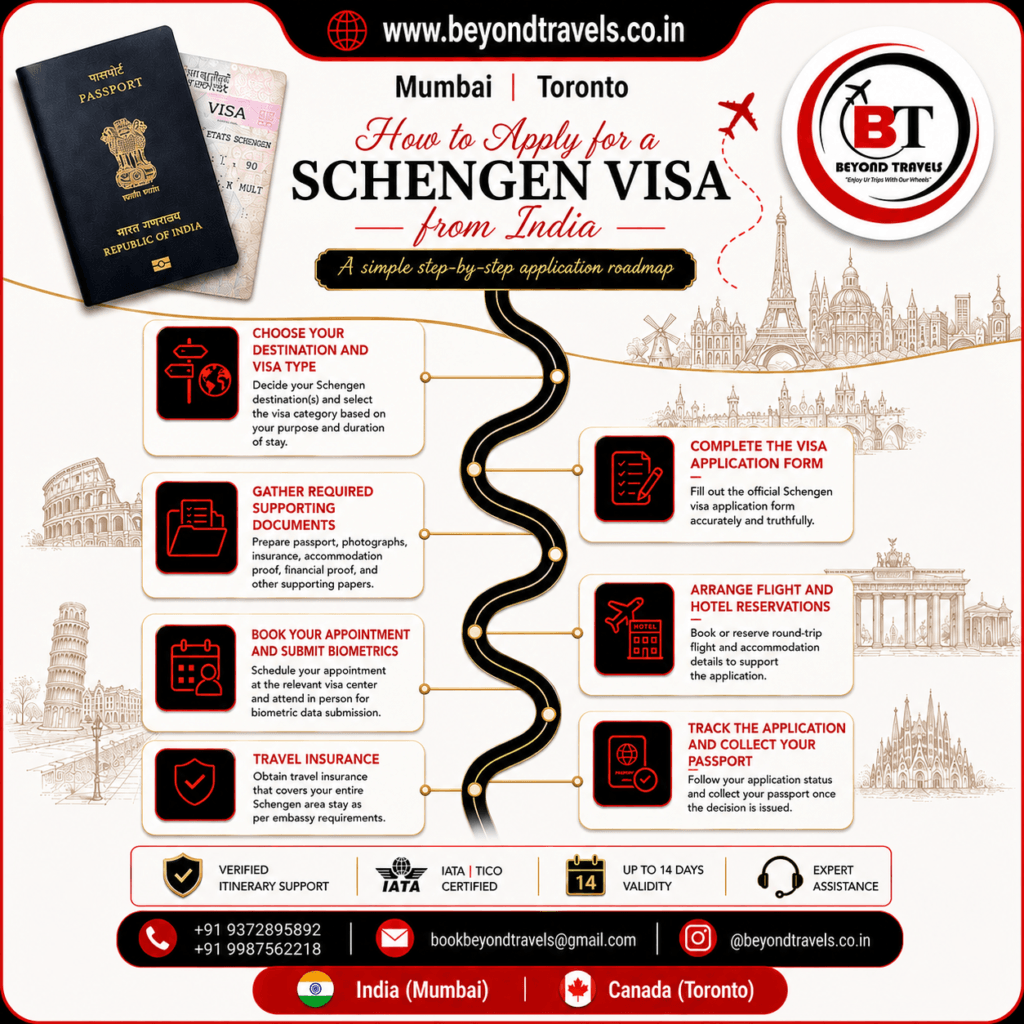
How to apply for a Schengen visa from India: a step-by-step 2026 roadmap
One visa, twenty-nine countries, and a continent of possibility. Applying for a Schengen visa from India is far less daunting than it looks once you know the exact order of steps. Here is the clear, up-to-date roadmap our visa desk uses to get Indian travellers approved and on their way to Europe.
Europe has a way of living in the imagination long before it lives in your passport. The canals of Amsterdam, a Paris cafe, the Alps at sunrise, a plate of pasta in Rome. The single document that unlocks all of it in one trip is the Schengen visa, and the good news is that the process, while detailed, is wonderfully logical. Follow it in order and it rarely surprises you.
A Schengen visa from India is a short-stay (Type C) visa that lets you travel across the Schengen area, currently 29 European countries, for up to 90 days within any 180-day period. Below is the exact roadmap, step by step, followed by the documents, costs, timelines and a few 2026 updates every traveller should know.
Applying for a Schengen visa from India, step by step
Choose your destination and visa type
Decide which Schengen country or countries you will visit, then pick the visa category that matches your purpose and duration, usually a short-stay tourist visa. If you are visiting several countries, you apply to the embassy of your main destination, meaning where you spend the most nights, or your first point of entry if the nights are equal.
Gather your supporting documents
Prepare your passport, photographs, travel insurance, accommodation proof, financial proof and other supporting papers. Getting this file right is the single biggest factor in an approval, so accuracy and completeness matter more than volume.
Complete the visa application form
Fill out the official Schengen visa application form carefully and truthfully. Small mismatches between your form, your documents and your itinerary are a common and avoidable cause of delay, so cross-check every detail before you sign.
Book your appointment and give biometrics
Schedule an appointment at the relevant visa centre, in India this is usually VFS Global, and attend in person to submit your file and provide biometric data (fingerprints and a photo). Book early, as slots fill quickly in peak season.
Arrange flight and hotel reservations
Provide round-trip flight reservations and confirmed accommodation details that match your itinerary. These are reservations to support the application; you generally should not buy fully paid, non-refundable tickets before your visa is approved.
Take out travel insurance
Buy travel medical insurance that covers your entire Schengen stay with a minimum coverage of EUR 30,000, as required by the embassies. This is mandatory, not optional, and the policy must be valid across all Schengen countries you visit.
Track your application and collect your passport
After submission, follow your application status online, and collect your passport once the decision is issued. Standard processing is around 15 calendar days, though it can take longer in busy periods, so never cut it fine against your travel date.
Documents you will need
Requirements vary slightly by country and purpose, but almost every Schengen visa application from India rests on the same core file. Prepare these carefully.
- Valid passport. Issued within the last 10 years, valid at least three months beyond your planned departure from Schengen, with two blank pages.
- Completed application form. Signed, accurate and matching your supporting documents.
- Photographs. Recent, in the Schengen specification (size, background and format).
- Travel medical insurance. Minimum EUR 30,000 cover, valid across the Schengen area for your whole trip.
- Flight and accommodation proof. Round-trip reservations and confirmed stays aligned to your itinerary.
- Financial proof. Recent bank statements, income-tax returns and, where relevant, a sponsorship letter.
- Cover letter and itinerary. A clear day-by-day plan and a short letter explaining your trip.
- Proof of ties to India. Employment or business papers, leave approval, or study enrolment, showing your intent to return.
Fees, processing and how early to apply
Budget for two costs: the government visa fee and the visa centre's service charge. Timelines are generous if you start early and tight if you do not.
| What | Details |
|---|---|
| Adult visa fee | Approximately EUR 90 (around Rs 8,000), with reduced fees for children; plus VFS Global service charges. |
| Stay allowed | Up to 90 days within any 180-day period across 29 Schengen countries. |
| Standard processing | Around 15 calendar days; can extend in peak season or if extra checks apply. |
| When to apply | Up to six months before travel, and at least 15 working days before; booking 4 to 6 weeks ahead is wise. |
| Where to apply | Through the authorised visa centre (commonly VFS Global) for your main-destination embassy. |
Fees and timelines are indicative and revised periodically. Confirm current figures with the relevant embassy or visa centre before you apply.
What has changed at Europe's borders
Two modernisation projects are worth knowing about, because they change the experience at the border even though they do not change your need for a visa.
- EES is live. The EU's Entry/Exit System went live in 2026 and digitally records non-EU travellers entering and leaving the Schengen area, gradually replacing the physical passport stamp with a digital record.
- ETIAS is coming, but not for visa holders. The upcoming ETIAS travel authorisation applies to visa-exempt nationalities. If you travel to Europe on a Schengen visa from India, you still use your visa; ETIAS does not replace it.
A word on approvals
No agent, anywhere, can guarantee a visa; the decision rests solely with the embassy. What a certified desk can do is make your application as strong, consistent and complete as possible, which is exactly where avoidable refusals are prevented. Be truthful, be thorough, and apply in good time.
Common mistakes that cause refusals
Most Schengen refusals are not about who you are; they are about how the application was put together. Sidestep these frequent errors and you remove the majority of avoidable risk.
- Weak or unclear finances. Bank statements that look thin, sudden large deposits just before applying, or unexplained funds raise questions. Show steady, genuine financial capacity.
- Inconsistent itinerary. When your flights, hotels, cover letter and form do not line up, officers notice. Keep every document telling the same story.
- Insufficient insurance. A policy below EUR 30,000 or one that does not cover the full trip is a straightforward rejection. Match the requirement exactly.
- Applying to the wrong embassy. Filing with a country that is not your main destination can invalidate the application. Confirm the right one first.
- Leaving it too late. Rushed files with missing papers are the classic cause of stress and refusal. Start early and build in buffer.
Let us map it for you
You can absolutely do this yourself, and this guide is written so you can. But if you would rather hand the detail to specialists who do it every week, that is exactly what our visa desk is for.
- Document review. We build and check your file against current embassy requirements, so nothing is missing.
- Bookings and insurance. We arrange compliant flight and hotel reservations and EUR 30,000 travel insurance.
- Itinerary and support. Verified itinerary support, appointment guidance and updates until your passport is back in your hands.
Frequently asked questions
How long does a Schengen visa from India take?
Standard processing is around 15 calendar days from your appointment, though it can take longer during busy travel seasons or if additional checks are needed. Apply at least a few weeks before travel, and up to six months ahead, to stay comfortable.
How much does a Schengen visa cost for Indians?
The adult government visa fee is approximately EUR 90 (around Rs 8,000), with reduced fees for children, plus the visa centre's service charge. Confirm the current fee with the embassy or VFS Global, as it is revised periodically.
Which country should I apply to for a Schengen visa?
Apply to the embassy of your main destination, the country where you will spend the most nights. If your nights are split equally, apply to the country of your first entry into the Schengen area.
Is travel insurance mandatory for a Schengen visa?
Yes. You must have travel medical insurance covering a minimum of EUR 30,000, valid across the Schengen area for the full duration of your stay. It is a core requirement, not an optional extra.
Can Beyond Travels help me apply for a Schengen visa from India?
Yes. As an IATA and TICO certified travel and visa desk, we help you choose the right embassy, build and review your documents, arrange compliant bookings and insurance, and guide you to appointment and passport collection.
Dreaming of Europe? Let's get your Schengen visa sorted
From document review to flights, hotels and EUR 30,000 insurance, Beyond Travels handles your Schengen visa from India end to end. No obligation, no fee just to enquire.
Written by the Beyond Travels visa desk, your IATA and TICO certified travel and visa partner in Thane and Toronto.
Disclaimer: Schengen visa rules, fees, timelines and border systems are set by European authorities and can change without notice. This guide is general information reflecting details available at the time of writing, and is not legal advice. Always confirm current requirements with the relevant embassy, the authorised visa centre (such as VFS Global), or Beyond Travels before applying.